
joy.ful.home's post
1 / 3
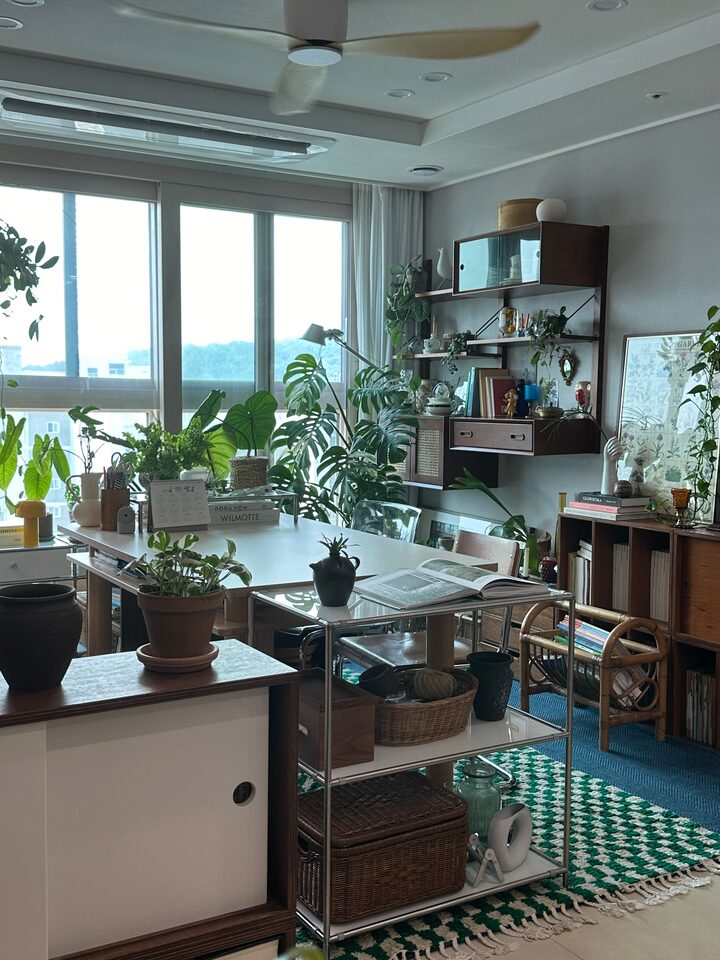
#GreenHomeProject_Part.2 Who is the living room for? ‘What if our house becomes a forest?’ As the title of author Jeong Jae-gyeong’s book suggests, the work of creating a forest in a small apartment in the city started in the living room. The area in front of the large window in the living room is the most light-receiving area and is well-ventilated, making it the most suitable place for plants to live. That’s why most of the plants in my house live huddled together by the living room window. The plants always stand facing out the window. In order to capture the shape of the plants nicely, the butler must always be content to live one step behind and look at the back of the plants’ heads. ‘It’s okay if you don’t look at me. Your concave back of your head… … is cool!’ Just like the days when I felt excited and happy just by seeing the back of my crush. ☺️🥰 In the living room, a ceiling fan is installed on the ceiling for ventilation in all seasons, and two circulators are running 24 hours a day. One of the important things I learned while growing plants is ventilation. Pests love plants in stagnant spaces without air circulation. In particular, pests like spider mites and root flies, which are cute in name only, are common. To avoid these unwelcome guests, help air circulation with a circulator and keep plants apart as much as possible. Plants are beautiful when they are together, but each has its own charm, so they shine when they are alone in an appropriate space. However, reality is not so easy. As someone who has little real estate compared to my appetite (plant greed), I have to somehow live by embracing and supporting myself. 😇 I go around every corner of the living room and look for a space where plants can thrive. I put plants that require strong light on the first row of living room windows. These are plants waiting for news of flowers, plants that respond to light to create patterns, succulents, cacti, and other plants. Plants that are in the semi-shade are placed on the living room table within 2 meters of the window or the second row of windows. Most plants that are not very sensitive to light can grow well in this middle space. Plants that can withstand a little darkness are mostly plants with large leaf surfaces, such as celery, ferns, monstera, spathiphyllum, and skin tapsus. They can live in the deeper part of the living room, which is called the shade, but it is not easy for them to grow well, so it is good to install plant bulbs to supplement the light. In fact, all the lights in my house are equipped with plant bulbs. Thanks to this, no matter where you pass by in the living room, there are plants taking root. In other words, there are no more empty spaces in my living room! 🫢 My empty spaces, which are more famous than anyone else's, are also filled by plants. Even when I feel empty, I live with plants that are like 'affection' that I know without saying anything, like a friend who silently listens to my worries. ☺️ #Record Club #그린홈프로젝트 #거실플랜테리어 #거실인테리어
- 2024.06.21
- Likes
- 14
- Saved
- 9
- Views
- 431
Comments0
